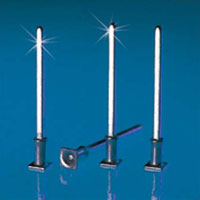
Surface Mount pins and posts are specially designed for high-reliability PCB interconnection applications. They are
available in 0.025" square (0.64mm), 0.040" (1.02mm),
0.043" (1.09mm), 0.060" (1.52mm), and 0.080" (2.03mm)
diameters.
To increase interconnection reliability, they utilize the capillary action of reflowing solder to improve solder joint
strength. Pull-force tests reveal that a post with proper
capillary action has much higher retention to the printed
circuit board than a post without the capillary action
feature.
The higher retention force is attributable to two conditions:
- The first is the very thin layer of solder between the
base of the pin and the solder pad. Solder is a weak alloy
with a low yield stress. A thicker layer of solder will fail
before a thinner layer will. Solder behavior is analogous to
that of adhesive: undeniably a thinner layer of adhesive
bonds more strongly than a thicker layer.
- As the solder paste reflows, flux and other active
ingredients in the solder cause outgassing. These gasses get
trapped under a relatively large surface like the base of the
pin. The trapped gasses create voids in the solder that are
clearly visible when the pin is pulled off or the solder joint
is cross-sectioned. Pins that employ capillary action have
fewer and smaller voids because the capillary tube provides
a way for gasses to escape. Cracks in solder joints develop
from such voids during thermal cycling. Field evaluations
show that posts with enhanced capillary action are more
resistant to the effects of thermal cycling.
|
|







 Surface Mount